


Following the latest blog posts on the Skillscapes Observatory and the respective applications for stakeholders and employees the Skillscapes project complements its “Tourism 2030” toolkit, by adding the Skillscapes Applications Hub.
The Hub is one of the five major pillars of the “Tourism 2030 Toolkit,” enabling seamless interaction between the platform’s digital services, APIs, geospatial tools, and cognitive databases.
The Applications Hub was developed by the Data and Web Science Lab (Datalab) of the School of Informatics at Aristotle University of Thessaloniki, coordinated by the Labour Geography Research Laboratory.
It acts as the technological backbone of the Skillscapes ecosystem. It connects all major platform components into a unified environment that supports interoperability, scalability, and open innovation.
Rather than functioning as a standalone application, the Hub enables communication and data exchange across the entire Tourism 2030 Toolkit.
This integrated architecture allows researchers, institutions, businesses, and policymakers to access consistent and actionable labor market intelligence.
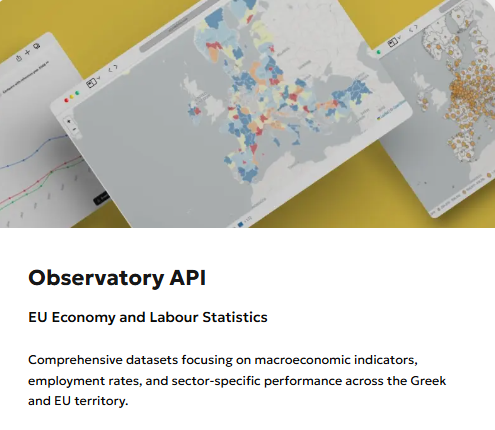
The Observatory API provides structured access to data hosted within the Skillscapes Observatory ecosystem, and includes its AI Agent (found at the bottom left corner of the Observatory).
Through this API, users can retrieve timeseries (filterable by variable, geographical entity, and year range) of:
The API supports analysis at NUTS3 regional level, allowing policymakers and researchers to study tourism workforce trends with greater geographical precision. It is particularly useful for:
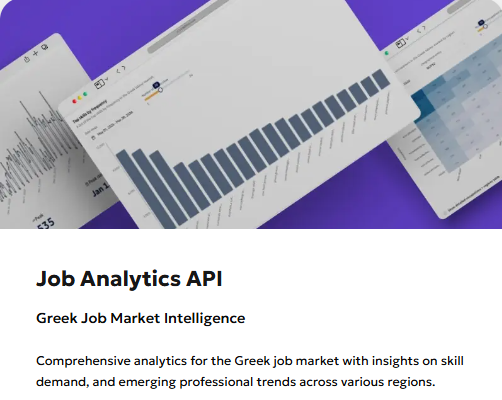
The Job Analytics API focuses on workforce and occupation-related intelligence.
It enables access to historical time-series of data regarding:
The service supports data-driven workforce planning and can help institutions monitor evolving labour market needs and emerging occupational trends.
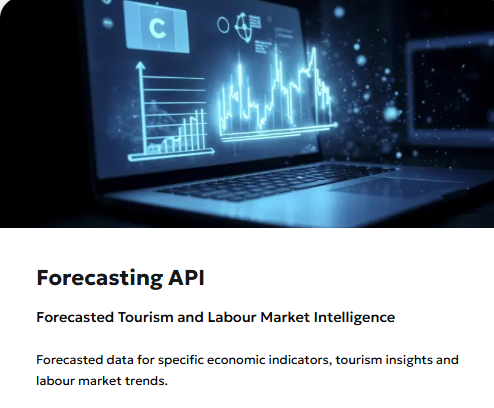
The Forecasting API provides predictive capabilities for tourism workforce and labour market analysis, and includes the Forecasted Data Web application.
It retrieves forecasts on:
The API contributes to proactive decision-making by helping stakeholders anticipate future employment developments rather than react to them retrospectively.
Specifically, such forecasting services are particularly useful for:
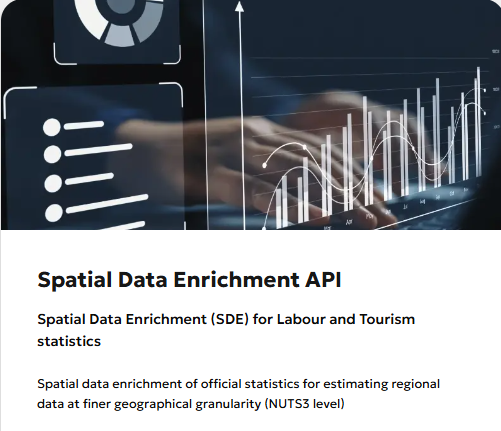
Finally, one of the Hub’s most advanced services is the Spatial Data Enrichment API and its respective Spatial Data Enrichment Web application.
This API enables:
It supports analysis at regional level (NUTS3), allowing researchers and policymakers to study tourism workforce trends with greater geographical precision.
More information on the Skillscapes project can be found at its official website https://skillscapesproject.eu and its social media pages on Facebook, LinkedIn and Youtube.
The project is being implemented as part of the National Recovery and Resilience Plan “Greece 2.0”, funded by the European Union – NextGenerationEU.