


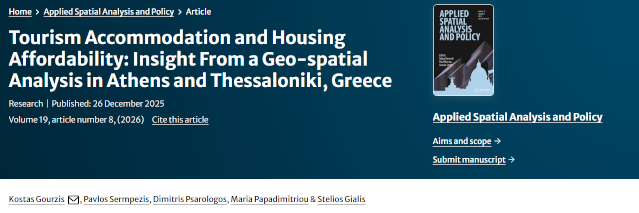
🔸Starting with the paper entitled “Tourism Accommodation and Housing Affordability: Insight From a Geo-spatial Analysis in Athens and Thessaloniki, Greece” looks at short-term and residential rental market separately, explores and understands their connection through spatial and non-spatial analysis.
Some of the key findings indicate that:
Μπορείτε να διαβάσετε τη δημοσίευση μέσα από το ResearchGateκαι πατώντας εδώ

The second paper of our project for 2026, is entitled “The evolving modalities of gentrification in Athens vis-à-vis Greece’s shifting growth models: Insight from a novel multi-scalar approach”.
Η δημοσίευση χρησιμοποιεί μια πολυεπίπεδη προσέγγιση για να εξετάσει τον εξευγενισμό στην Αθήνα στο πλαίσιο των μεταβαλλόμενων μοντέλων ανάπτυξης της Ελλάδας. Προσδιορίζει δύο κύματα του μέχρι τους Ολυμπιακούς Αγώνες του 2004, τα οποία αναδιαμόρφωσαν το κέντρο της πόλης κατά τη διάρκεια μιας περιόδου ανάπτυξης που βασίστηκε στην αστικοποίηση, ενώ ακολούθησαν δύο μεταγενέστερα κύματα κατά τα οποία ο εξευγενισμός επεκτάθηκε προς τα έξω και συνδέθηκε στενά με την τουριστικοποίηση.
Τα κύρια συμπεράσματά της δείχνουν ότι ο εξευγενισμός εξελίχθηκε από εκμετάλλευση των διαφορών ενοικίων στα κέντρα των πόλεων σε αναδιάρθρωση των αγορών ακινήτων με στόχο τον τουρισμό και τη εμπορευματοποίηση, ως αποτέλεσμα της μετάβασης της Ελλάδας από μια οικονομία βασισμένη στον κατασκευαστικό τομέα σε μια οικονομία που εξαρτάται από τον τουρισμό.
Μπορείτε να διαβάσετε ολόκληρη τη δημοσίευση κάνοντας κλικ εδώ
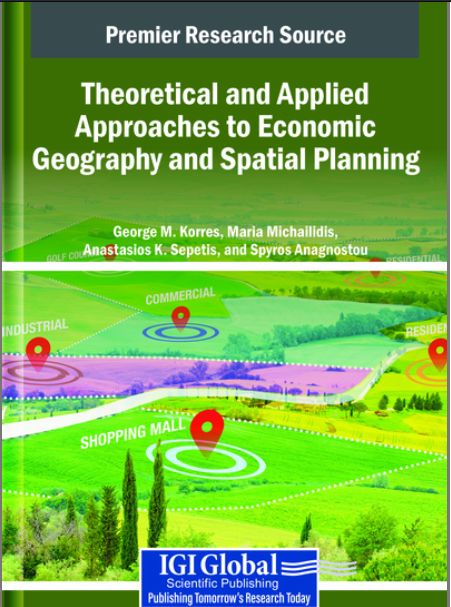
Τέλος, στο βιβλίο με τίτλο «Theoretical and Applied Approaches to Economic Geography and Spatial Planning», οι ερευνητές μας συνέβαλαν στη σύνταξή του, μέσω του κεφαλαίου με τίτλο «Examining Touristification in the EU Regions through a Composite Indicator Methodology”. Σε αυτό το κεφάλαιο η ομάδα μας παρουσιάζει τον Δείκτη Τουριστικοποίησης (TAIDD CI): έναν δείκτη που μετρά τις εδαφικές και κοινωνικές πιέσεις από την προσφορά και τη ζήτηση του τουρισμού, καθώς και την εξάρτηση των περιφερειών από τον τουρισμό όσον αφορά την απασχόληση και την παραγωγή.
Εφαρμόζοντας αυτόν τον δείκτη σε όλες τις περιφέρειες NUTS2 της ΕΕ, από το 2009 έως το 2022, το παρόν κεφάλαιο παρουσιάζει ορισμένα ενδιαφέροντα βασικά ευρήματα, όπως:
Μπορείτε να μεταβείτε στο κεφάλαιο κάνοντας κλικ εδώ